


#02: The impact of the Covid-19 pandemic on Africa's economy.
- Kwaku Kwarteng Bonsu
- Apr 20, 2020
- 4 min read
Updated: May 1, 2020


Worldwide map of confirmed Covid-19 cases : John Hopkins Coronavirus Resource Centre
The Corona virus isn’t only a public health emergency. It also poses a major threat to the world economy. It has already caused global stock markets to crash, raising fears of a recession. Some weeks ago, the African continent looked as if it was escaping the scale of infection in other parts of the world which could have eased the stress on its economy. Currently, the African continent has not been able to escape the infection of the corona virus, it is certain that the continent cannot escape the economic consequences of the pandemic.
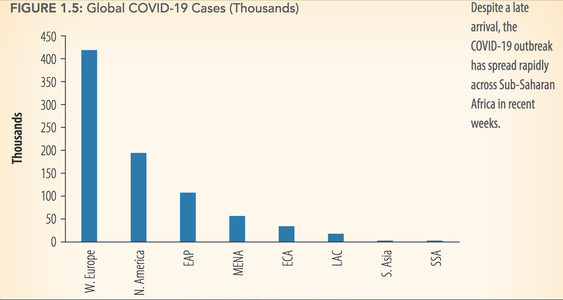
Global Covid-19 cases worldwide

In an article by Ken Ofori-Atta, Ghana's minister for finance; ‘What does an African finance minister do now?’, the minister of finance gives an insight into how most African Finance ministers are tackling the looming crisis. “Economic activity has been massively disrupted; hotels are closing, industry is tottering, airlines are grounded, and our toast-of-the-region airport lies asleep. A U-shaped recovery is touted, but ours will likely be a steep drop, then a two- to three-year downward slide before a recovery; a trapezoid-shaped recovery!” he stated.
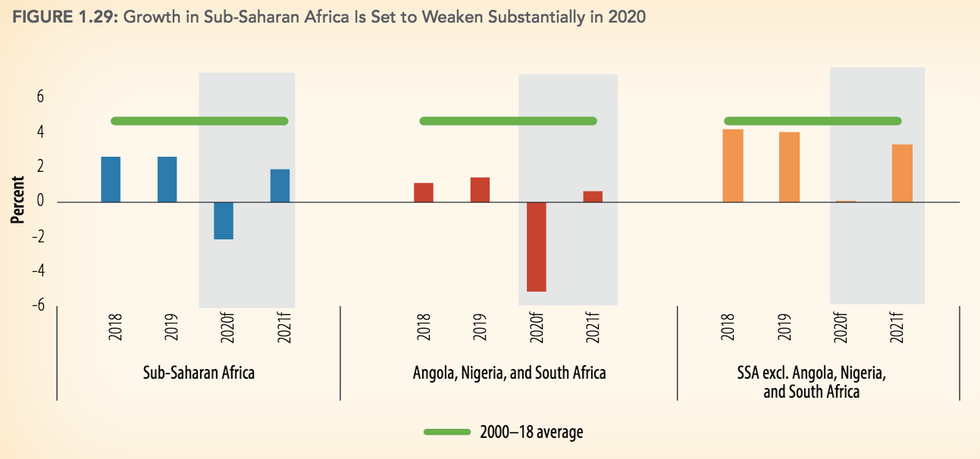
The World Bank released its biannual Africa’s Pulse report last week, which analyzes the macroeconomic outlook for sub-Saharan Africa. This edition focuses on the major challenges that COVID-19 presents to African economies. The report projects that, as a result of the pandemic, economic growth in sub-Saharan Africa will decline from 2.4 percent in 2019 to between -2.1 percent and -5.1 percent in 2020, depending on the success of measures taken to mitigate the pandemic’s effects. In other words, the report predicts that the region will experience its first recession in 25 years.
Figure 1 shows growth projections for the region in a scenario where the spread of the virus slows after an initial rapid spread, advanced economies lift containment measures after two months, and a variety of fiscal and monetary policies are enacted to lessen the economic effect of the pandemic. In this scenario, real GDP growth in sub-Saharan Africa is projected to decline to -2.1 percent in 2020 due to decreased economic activity in the region and disruption in the global economy, which will affect Africa’s participation in trade and value chains as well as reduce foreign financing flows. The decline will be primarily due to large contractions in South Africa, Nigeria, and Angola driven by their reliance on exports of commodities whose prices have already declined as well as other structural issues. Growth is projected to recover to positive levels by 2021, although it will remain below the levels of economic growth in 2018 and 2019.
Figure 1. Growth projections for sub-Saharan Africa, 2020 and 2021

The pandemic is also projected to widen fiscal deficits, particularly in commodity-exporting countries and countries dependent on tourism revenues. In the scenario described above, the revenue collected by sub-Saharan African governments is projected to be 12 percent lower than in a scenario without COVID-19. Because government spending will remain high in order to combat the effects of COVID-19, Africa’s overall fiscal balance is projected to deteriorate substantially, to around 2.7 percentage points of GDP higher than in a non-COVID-19 scenario.
African countries also face heightened public debt vulnerabilities: As Figure 2 shows, the ratio of general government gross debt-to-GDP in sub-Saharan Africa has gradually increased since 2012, rising from an average of 37 percent of GDP in 2012 to 59 percent of GDP in 2019. Even before the pandemic, many countries had resorted to more expensive sources of financing, such as sovereign bonds instead of concessional loans, due to liquidity problems stemming from the 2008-2009 global financial crisis and the 2011-2012 European debt crisis. These issues, combined with the deterioration in fiscal balances and the decline in economic activity in the region due to COVID-19, will make it more difficult for countries to repay their debt.
Figure 2. General government gross debt in sub-Saharan Africa, 2000-2019 (% of GDP)


As a result of these challenges, African governments will likely struggle to enact effective policies to fight COVID-19 while also preserving macroeconomic stability in the region. The report argues that financial assistance from multilateral organizations and official bilateral creditors—including temporary debt relief—will be needed to help Africa reduce the effects of the pandemic.
What do African leaders do now? How can they restore 10-15 per cent of GDP over a two- to three-year period? There are some structural elements that need fixing; formalising the economy; and Africa’s debt — the most controversial element and the topic of much discussion. Africa’s external debt stock is more than $700bn. Africa needs to pay $44bn to service our debt this year.
With the benefit of immediate debt relief, African governments should focus on protecting vulnerable populations and bolstering social safety nets. And, like governments elsewhere, they should also support the private sector, especially small- and medium-size enterprises. That includes paying these firms’ arrears, and ensuring minimal disruption to the flow of credit, in order to avoid a deeper and more prolonged banking and economic crisis.
Such measures will help to preserve jobs. Without them, Africa could face an unprecedented human and economic catastrophe that could morph into even costlier political and social instability.
The COVID-19 pandemic has revealed the extent of our interconnectedness, reminding us of how closely the fates of all countries are intertwined. The global health system is only as strong as its weakest link: Success in combating the pandemic in any country will be short-lived until every country succeeds. Beyond the immediate responses, therefore, the pandemic and its economic fallout highlight the longer-term efforts needed to strengthen Africa’s health systems, diversify its economies, and broaden domestic revenue sources. Achieving these goals matters not just for the continent, but for the entire world.
"To Get Lost is to find the way"
If you enjoyed reading this post, Subscribe for weekly newsletters


Comments